Is Bagasse Compostable? What UK Businesses Need to Know
Quick answer
Yes, bagasse is a plant fibre that breaks down, and certified bagasse products are compostable in industrial composting facilities. Home composting is slower and less predictable. In England, compostable packaging cannot go in workplace food-waste bins, so use a dedicated compostables collection or general waste.
Key takeaways
- "Biodegradable" has no time limit. "Compostable" means it passes a standard such as EN 13432 or ASTM D6400.
- Most bagasse tableware is certified for industrial composting, not home composting.
- Our round and pizza bagasse plates are certified to ASTM D6400 / D6868. Our 5-compartment plates are certified to EN 13432.
- Under England's Simpler Recycling rules, compostable packaging must not go in workplace food-waste bins.
Compostable vs biodegradable: what is the difference?
The two words are often used as if they mean the same thing. They do not.
- Biodegradable means microorganisms can break a material down over time. It says nothing about how long that takes or under what conditions. Many materials biodegrade eventually.
- Compostable is stricter. A compostable product must break down within a set time under composting conditions, turn into compost-quality material and leave no harmful residue. Independent tests to a published standard prove this.
So every compostable product is biodegradable, but not every biodegradable product is compostable.
| Term | What it promises | Proof |
|---|---|---|
| Biodegradable | Breaks down eventually | Usually none required |
| Industrially compostable | Breaks down in a commercial facility within a set time | Certified to EN 13432 or ASTM D6400 / D6868 |
| Home compostable | Breaks down in a garden heap at lower temperatures | Separate home-compost certification |
What do EN 13432 and ASTM D6400 mean?
EN 13432 is the European standard for packaging that can be recovered through industrial composting. It is widely used in the UK. ASTM D6400 is the US standard for compostable plastics, and ASTM D6868 covers coatings and products on paper or fibre. Both test that a product breaks down, disintegrates into small pieces and leaves no harmful substances in the finished compost.
Neither standard covers home composting. Products sold as home compostable carry a separate certification.
Industrial vs home composting
Industrial composting happens at large commercial sites. Waste is shredded, kept hot (often above 50°C), moist and well aired, and turned regularly. Certified compostable tableware is designed to break down in weeks to months in these conditions.
Home composting happens in a garden heap or bin. Temperatures are lower and change with the weather. Thick items like plates and boxes take much longer, and results vary from heap to heap. Tearing items into small pieces and keeping the heap moist helps.
 Open full size
How long does bagasse take to break down?
There is no single honest figure, because it depends on thickness, size, temperature, moisture and how often the pile is turned.
- Industrial composting: certified products must meet the time limit set by their standard. In well-run facilities, bagasse typically breaks down within a few months.
- Home composting: expect a longer and less predictable timeline, often several months or more for thick plates.
- Landfill or a sealed bin: very slow, because there is little oxygen. This is why disposal route matters.
Be wary of any supplier quoting an exact number of days for every situation.
Our bagasse products and their certifications
| Product | Certification | Composting route |
|---|---|---|
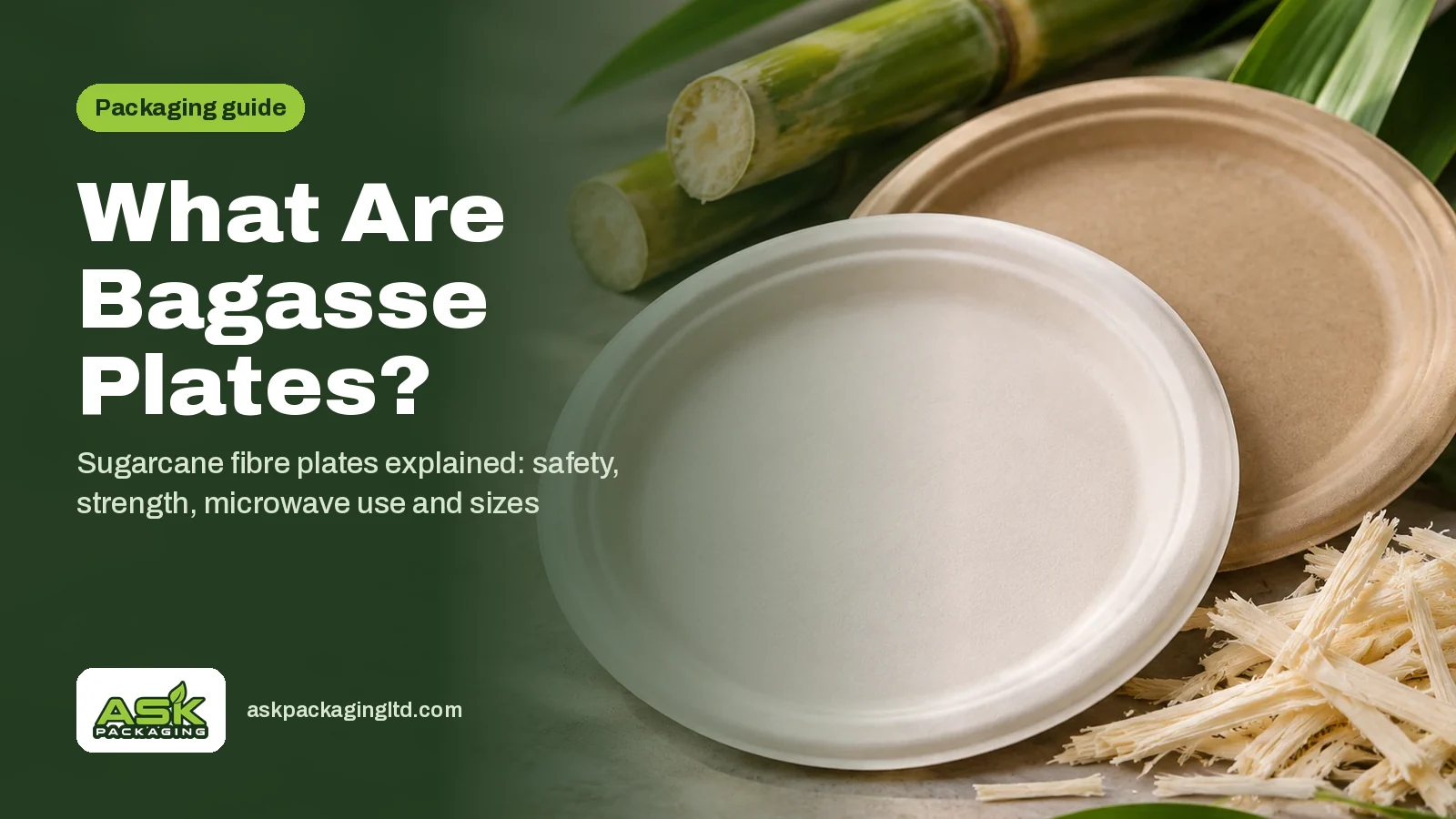
| Round bagasse plates (7 to 12 inch) | ASTM D6400 / D6868 | Industrial, where accepted |
| 12 inch bagasse pizza plates | ASTM D6400 / D6868 | Industrial, where accepted |
| 5-compartment bagasse plates | EN 13432 | Industrial, where accepted |
We do not describe any product as home compostable unless it carries home-compost certification. Our other bagasse products are moulded from the same sugarcane fibre. Ask us for the documents for a specific product before you make claims on your menu.
How to dispose of bagasse in the UK
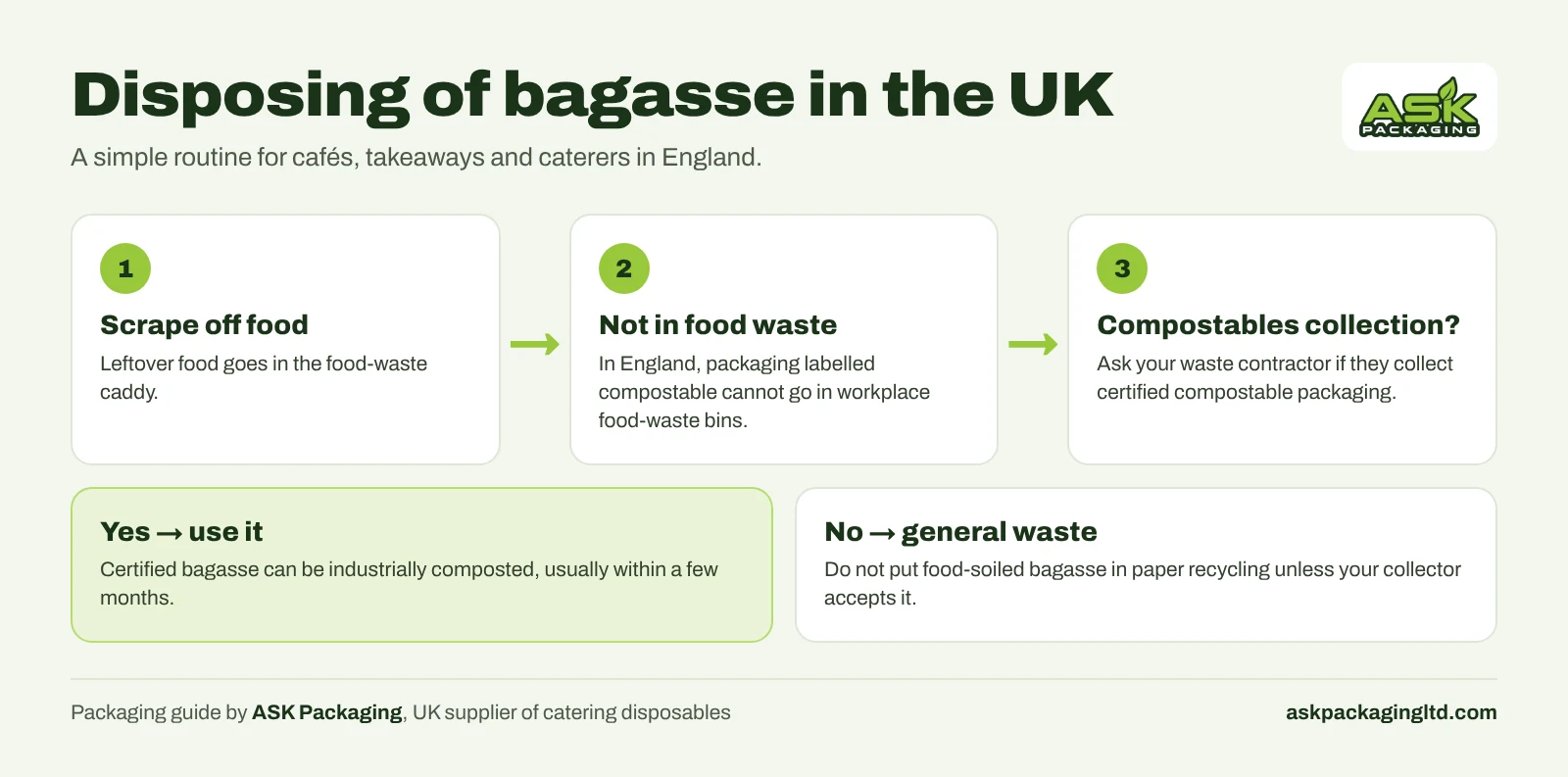
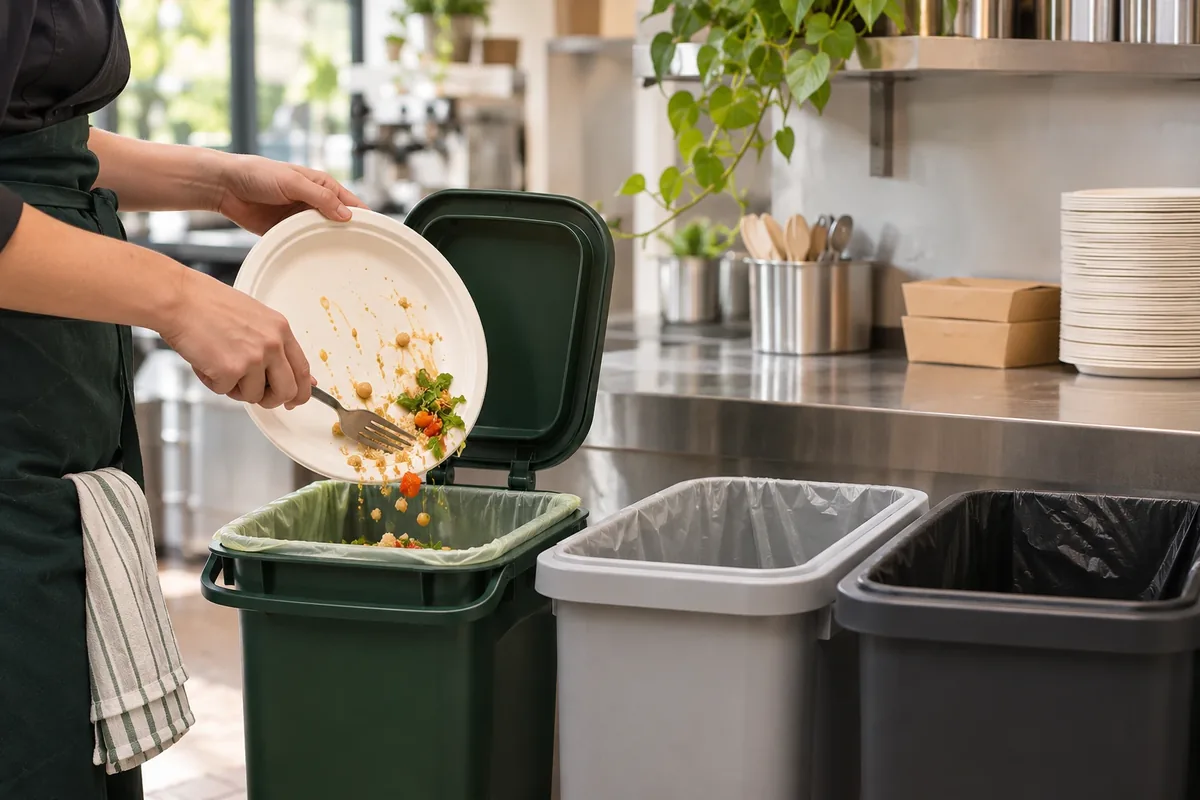
- Scrape off leftover food into your food-waste caddy. Food goes in food waste.
- Do not put the bagasse item in the food-waste bin. In England, the Simpler Recycling rules say packaging labelled compostable or biodegradable cannot be recycled with food waste.
- Check for a compostables collection. Some waste contractors run a separate service for certified compostable packaging. If yours does, use it.
- Otherwise, use general (residual) waste. Do not put food-soiled bagasse in paper or card recycling unless your collector says it is accepted.
- At home, follow your council’s rules. You can try a home compost heap, torn into small pieces, but expect slow results.
Why this matters for your business
Since 31 March 2025, workplaces in England with 10 or more full-time employees must separate food waste, dry recycling and general waste. Micro-businesses with fewer than 10 full-time employees follow from 31 March 2027.
If you sell food in compostable packaging: – Keep certificates on file and only make claims you can back up. – Tell customers how to dispose of it. “Compostable in industrial facilities, where accepted” is clearer than “eco-friendly”. – Talk to your waste contractor about a compostables collection if you use a lot of bagasse.
The UK’s Green Claims Code expects environmental claims to be clear, accurate and backed by evidence, so vague claims put a business at risk.
Is bagasse better than plastic for the environment?
Bagasse has real advantages. It is made from a by-product of sugar production, it is plant-based and plastic free, and certified products can be composted where facilities exist. It also lets caterers stay within the single-use plastics rules for plates, bowls and polystyrene containers.
The full environmental picture depends on transport, energy use and, above all, disposal. A bagasse plate sent to landfill gives far less benefit than one that is composted. Choosing bagasse and arranging the right waste route gives the best result.
Common mistakes
- Calling a product “biodegradable” as if that proves anything. Use the certified term and the standard.
- Putting compostable packaging in the workplace food-waste bin. Not allowed in England.
- Claiming home compostability without certification. Most bagasse is certified for industrial composting only.
- Putting greasy bagasse in paper recycling. It contaminates the paper stream.
Products in this guide
Prices include VAT, with free UK mainland delivery and no minimum order.
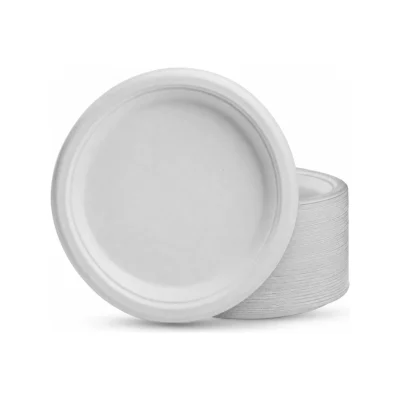 9 Inch White Bagasse PlatesFrom £7.90 inc VATView pack sizes
 5-Compartment Bagasse Plates (10 x 8.3 Inch)From £11.99 inc VATView pack sizes
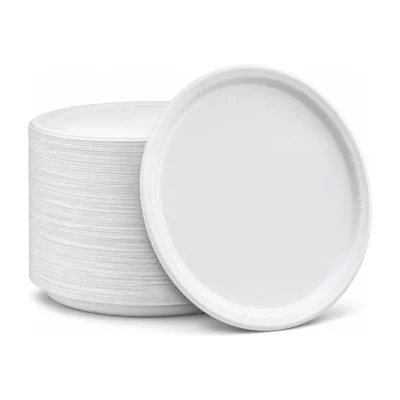 12 Inch Bagasse Pizza PlatesFrom £14.79 inc VATView pack sizes
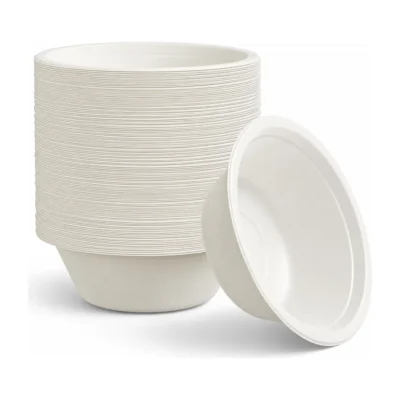 350ml White Bagasse Bowls (12oz)From £6.99 inc VATView pack sizes
 9 x 6 Inch Bagasse Clamshell BoxesFrom £11.99 inc VATView pack sizes
Frequently asked questions
Is bagasse biodegradable?
Yes. Bagasse is a plant fibre that microorganisms can break down. Certified bagasse products go further and meet compostability standards, which set time limits and require no harmful residue.
Is bagasse home compostable?
Only if the product carries home-compost certification. Most bagasse tableware, including ours, is certified for industrial composting, where higher temperatures break it down faster and more reliably.
Can I put bagasse plates in my food waste bin at work?
No, not in England. Simpler Recycling guidance says packaging labelled compostable or biodegradable cannot go with food waste. Scrape food into the caddy and dispose of the plate separately.
Can bagasse go in paper recycling?
Food-soiled bagasse is usually not accepted in paper and card recycling, because grease and food contaminate the stream. Ask your waste collector before putting any bagasse in recycling.
What is the difference between EN 13432 and ASTM D6400?
EN 13432 is the European standard for industrially compostable packaging. ASTM D6400 is the US equivalent for compostable plastics, with ASTM D6868 covering fibre-based products and coatings.
How should a takeaway describe compostable packaging?
Name the certification and the disposal route, such as "certified compostable in industrial facilities, where accepted". Avoid vague words like eco-friendly unless you can back them up.
Does bagasse break down in landfill?
Very slowly. Landfill sites have little oxygen, so fibre breaks down poorly. That is why sending certified bagasse to a composting facility gives a much better environmental result.
Sources
- GOV.UK: Simpler Recycling – workplace recycling in England
- GOV.UK: Green Claims Code – making environmental claims
Checked on 12 November 2026. Rules change, so always check the latest official guidance.

About ASK Packaging
ASK Packaging Ltd supplies plates, bowls, food containers, bags, cups, napkins and cutlery to cafés, takeaways, caterers and event hosts across the UK. We are based in Wellingborough, Northamptonshire, and have been trading since 2018. Our guides are written from the questions our customers ask us every day.